EPIC TOOLBOX | INPATIENT VIRTUAL CARE | Deployed Day One
Meet Nesa ONE. The intelligent platform for inpatient care.
Nesa ONE takes an Epic-first approach, connecting virtual care, room intelligence, video, communication, and alerts within the workflows clinicians already use across inpatient care.
Nesa augments clinical awareness with on-device room intelligence, surfacing patient movement, bed-exit events, and room activity in real time. AI, computer vision, video, and integrated device data connect directly into Epic workflows.
Customer-reported results demonstrate measurable operational and financial value across Nesa-supported programs.
“This has been an insurgent technology, and itʼs going to become the incumbent.
Whatʼs interesting with this technology is, and this is critical, itʼs actually decreasing the burden on our staff because now the floor nurse can have augmentation for documentation.ˮ
Edward Sankary, MD, FACP, FAMIA
VP, Chief Health Information and Chief Value Officer
8x lower turnover than the rest of the hospital.
1.2% on the virtual nursing units vs. 10% house-wide. ~$1.3M in replacement cost avoided.
Zero CAUTI. Zero high-stage HAPI.
Across 6,477 patient days.
82% SEP-1 compliance vs. 64% national average.
Represents ~23 more patients receiving SEP-1–compliant care than expected at the national benchmark.
94% of rapid responses covered.
The virtual nurse documents and places orders, allowing bedside nurses to focus on the patient.
Nesa ONE
More than integration. A true epic extension. Clinical-grade hardware and intelligence layer. Epic-first integrated platform.
3.75M+
Epic API calls annually
CAL + ECAL/Monitor Virtual care workflows inside Epic.
Haiku + Canto + Rover + MyChart Beside TV Access across Epic applications
2025 · 2026 · 2027 Toolbox alignment across successive Epic requirements. Six months ahead of market.
Not all Epic Toolbox integrations are built the same. Nesa is designed to make Epic the operating environment for inpatient virtual care. Video, alerts, documentation, and room intelligence work directly within Epic workflows, supported by 3.75 million Epic API calls annually across Nesa deployments.
Same Toolbox. Different Depth.
Solve the problem of stacked infrastructure.
Today, clinicians toggle between systems. Alerts compete for attention. IT manages multiple security reviews. Data never connects, and clinical workload doesn’t improve. Stop managing multiple vendors. Start deploying clinical capacity.
Today — stacked point solutions
Ambient documentation from one vendor
Tele-stroke platform from a second
Fall detection AI from a third
No Epic CAL or ECAL live integration
Result: Multiple security reviews, duplicate Epic integrations, fragmented data, PHI in vendor clouds, separate training programs, complex vendor management
With Nesa one + Epic
Vision + language AI running on the same device with "Chart with Art" integration
One security review. One Epic integration. Built for day-one deployment across CAL, ECAL/Monitor, Haiku, Canto, and Rover
Alerts prioritized and contextualized in one workflow embedded inside Epic Monitor
All processing on-device — nothing leaves your network
Result: Consolidated costs, simplified IT management, unified data model, scalable across unlimited use cases
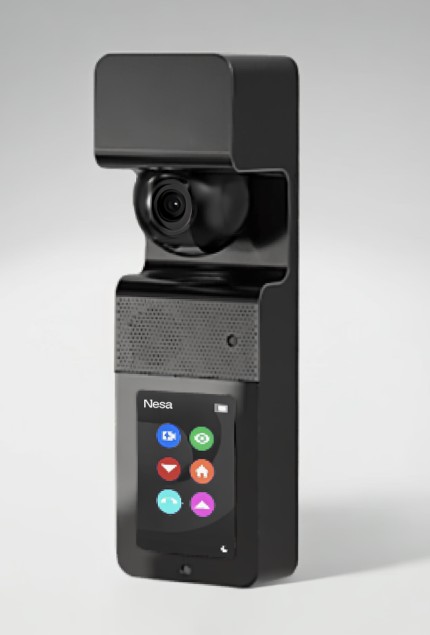
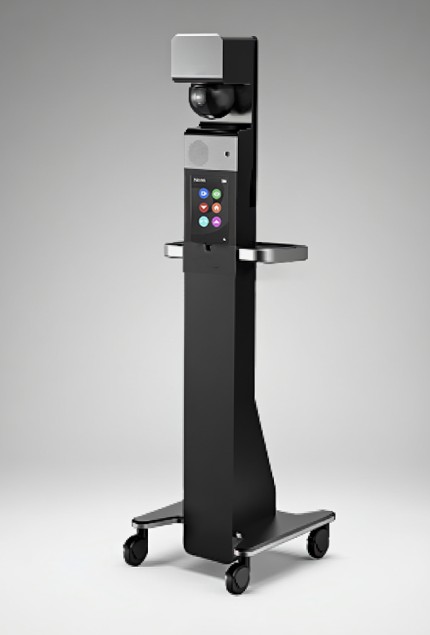
Flexible hardware,
Designed for hospital rooms.
01
Fixed Wall Mount
02
Mobile Cart
Clinical grade vision
4K high-resolution optics
Captures clinical detail for any virtual care workflow, from ED, med-surg, and NICU to tele consults, virtual nursing, and home.
360° awareness + 25× optical PTZ
Full line of sight. Reads IV bags, wristbands, and surgical device labels.
Low-light IR + HDR/WDR
Clear imaging in dimmed NICU rooms and overnight conditions.
NDAA-compliant hardware
Built to federal procurement standards for regulated healthcare environments.
Clinical grade audio
Highest speech intelligibility
Whisper AI captures patient voices even in noisy clinical environments. Integration with “Chart with Art”, Abridge, Ambience, Suki, and other third-party tools.